
By DosNextGen India Private Limited
India’s cities are expanding vertically and horizontally at an unprecedented pace. Residential complexes grow denser. Commercial corridors grow busier. Yet one urban resource remains critically strained — parking space.
Across Delhi NCR and other major urban clusters, the parking crisis is no longer an inconvenience. It is a structural urban challenge. And quietly, abandoned and End-of-Life Vehicles (ELVs) are intensifying the problem.
When Roads Become Storage Yards
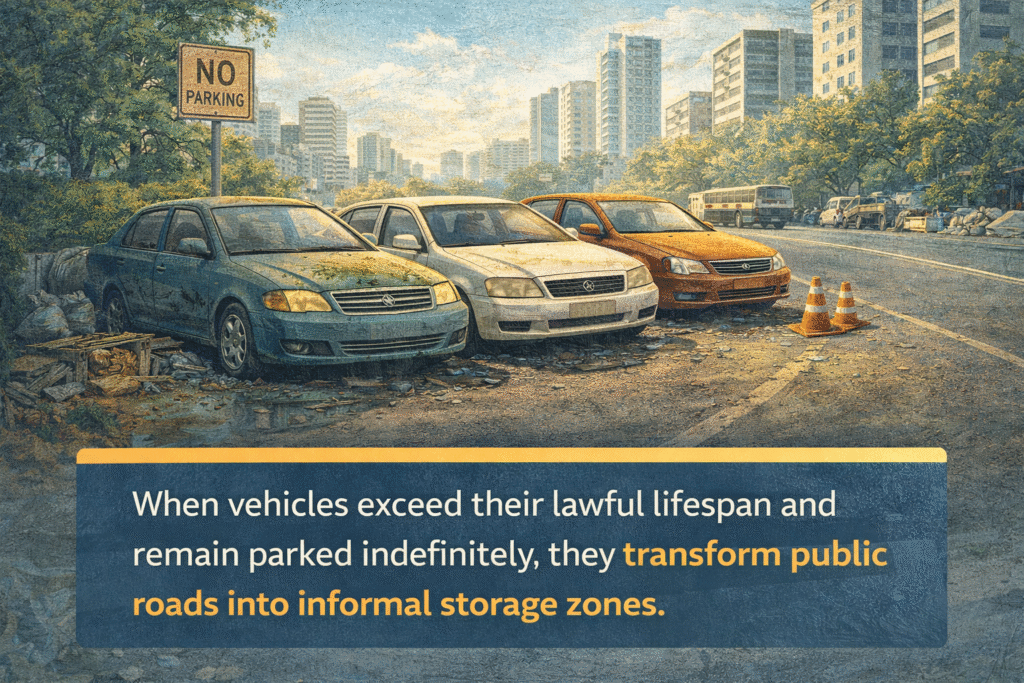
In many neighbourhoods, unused vehicles occupy valuable curb space for months — sometimes years. These are often diesel vehicles older than 10 years or petrol vehicles older than 15 years, no longer compliant under prevailing norms but not yet responsibly retired.
An abandoned vehicle may appear harmless. It does not move. It does not honk. It does not congest traffic.
But it occupies.
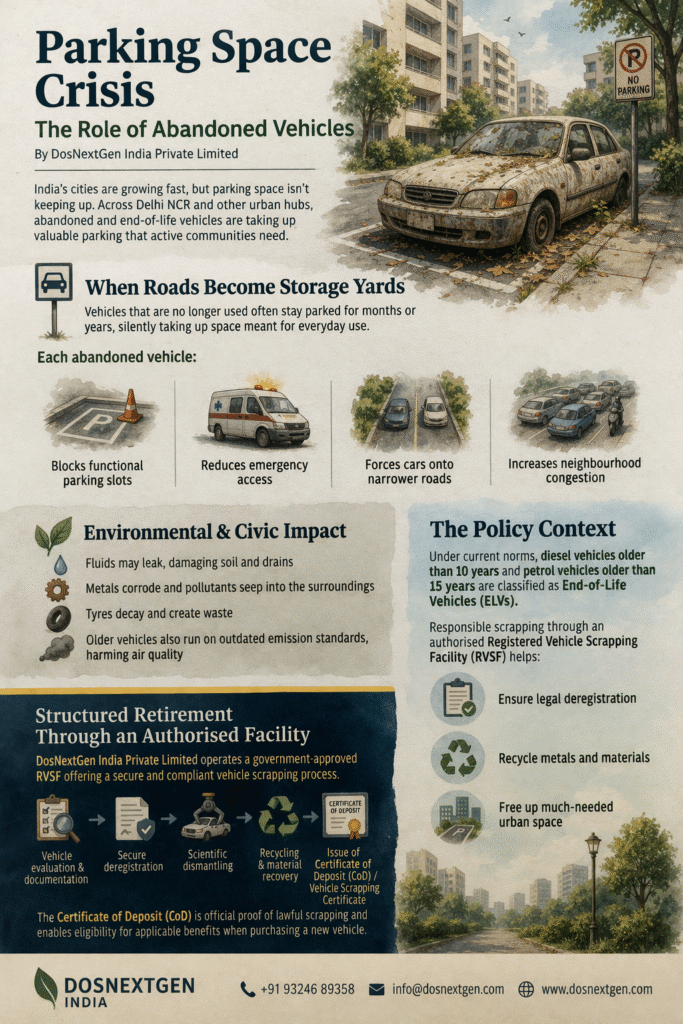
Each stationary, unused vehicle:
- Blocks functional parking slots
- Reduces emergency access space
- Forces active vehicles onto narrower roads
- Increases neighbourhood congestion
In dense regions such as Delhi, Haryana, Uttar Pradesh, Rajasthan, and areas including Hapur (Delhi NCR), space is no longer a luxury. It is infrastructure.
When vehicles exceed their lawful lifespan and remain parked indefinitely, they transform public roads into informal storage zones.
Environmental and Civic Impact
Beyond spatial pressure, abandoned vehicles contribute to environmental degradation.
Unused vehicles deteriorate over time. Fluids may leak. Metal components corrode. Tyres decay. When scrapping is delayed, environmental risks accumulate.
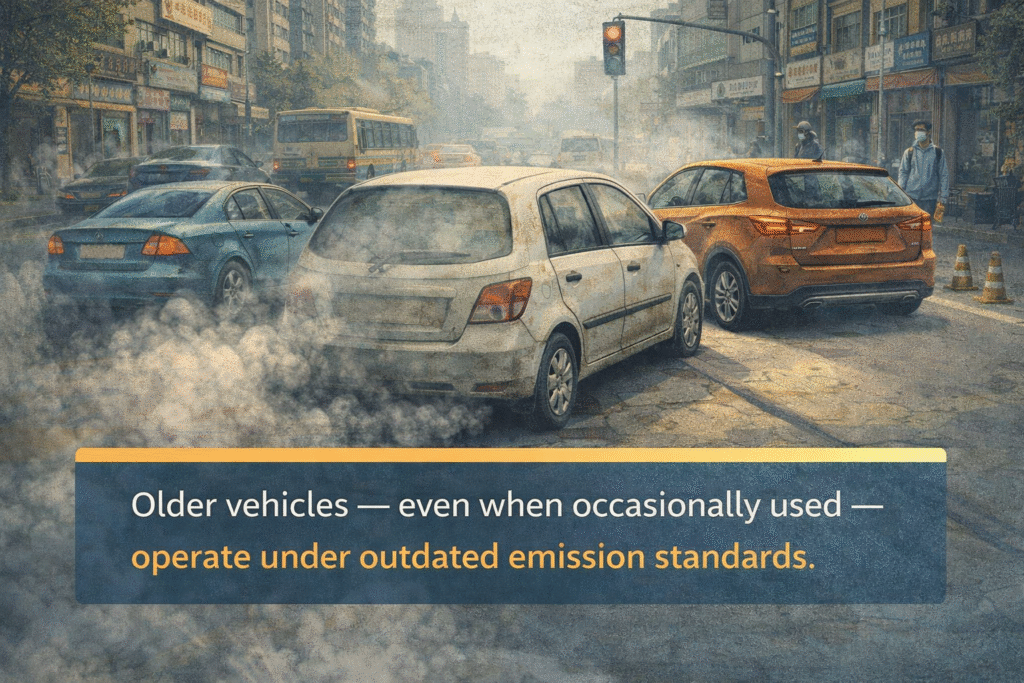
Older vehicles — even when occasionally used — operate under outdated emission standards. Many were manufactured long before Bharat Stage VI (BS-VI) compliance, making them less fuel-efficient and more pollutant-intensive.
Thus, the parking crisis intersects with the environmental crisis.
A vehicle that no longer serves mobility should not continue to occupy urban land.
The Policy Context
India’s Vehicle Scrappage Policy aims to modernise the national fleet, reduce emissions, and encourage responsible vehicle retirement. However, policy effectiveness depends on participation.
Abandoned vehicles reflect a gap between regulation and action.
Responsible decommissioning through an authorised Registered Vehicle Scrapping Facility (RVSF) ensures:
- Legal closure of registration
- Safe dismantling of hazardous materials
- Recycling of recoverable metals
- Release of occupied urban space
This is where DOSNEXTGEN INDIA contributes meaningfully.
Structured Retirement Through an Authorised Facility
DosNextGen India Private Limited operates a government-approved RVSF dedicated to compliant and environmentally responsible vehicle dismantling.
The process is systematic:
- Vehicle evaluation and documentation
- Secure deregistration
- Scientific dismantling
- Recycling and material recovery
Upon completion, the owner receives a Certificate of Deposit (CoD) — often referred to as a Vehicle Scrapping Certificate.
The Certificate of Deposit (CoD) serves as official proof that the vehicle has been dismantled in accordance with regulatory standards. It also enables eligibility for potential benefits when purchasing a new vehicle.
By obtaining a Vehicle Scrapping Certificate through DOSNEXTGEN INDIA, owners not only achieve legal compliance but also release valuable urban space back into circulation.
Reclaiming Urban Order
Parking shortages create cascading urban inefficiencies:
- Increased search time for drivers
- Traffic bottlenecks
- Resident disputes
- Strain on civic authorities
In housing societies, abandoned vehicles frequently become a point of tension. They symbolise inaction in spaces that require collective responsibility.
Removing unused vehicles restores order.
Scrapping is not solely an environmental decision. It is an urban planning contribution.
A Responsible Transition
India’s cities cannot sustain indefinite accumulation of non-functional vehicles. Space is finite. Infrastructure is strained. Air quality remains fragile.
Choosing authorised scrapping reflects a shift in mindset — from possession to responsibility.
At DOSNEXTGEN INDIA, every vehicle dismantled represents:
- Reduced environmental risk
- Released urban space
- Recovered recyclable material
- Alignment with national mobility reform
The parking crisis is not only about inadequate infrastructure. It is also about unused assets occupying active cities.
Urban progress requires movement. When vehicles stop serving mobility, responsible retirement becomes essential.
Free Up Space. Free Up Responsibility. Connect with Us Today.
📞 +91 93246 89358
📧 info@dosnextgen.com
🌐 www.dosnextgen.com