
By DosNextGen India Private Limited
An old vehicle is often seen as waste — a rusting body, declining performance, rising maintenance costs.
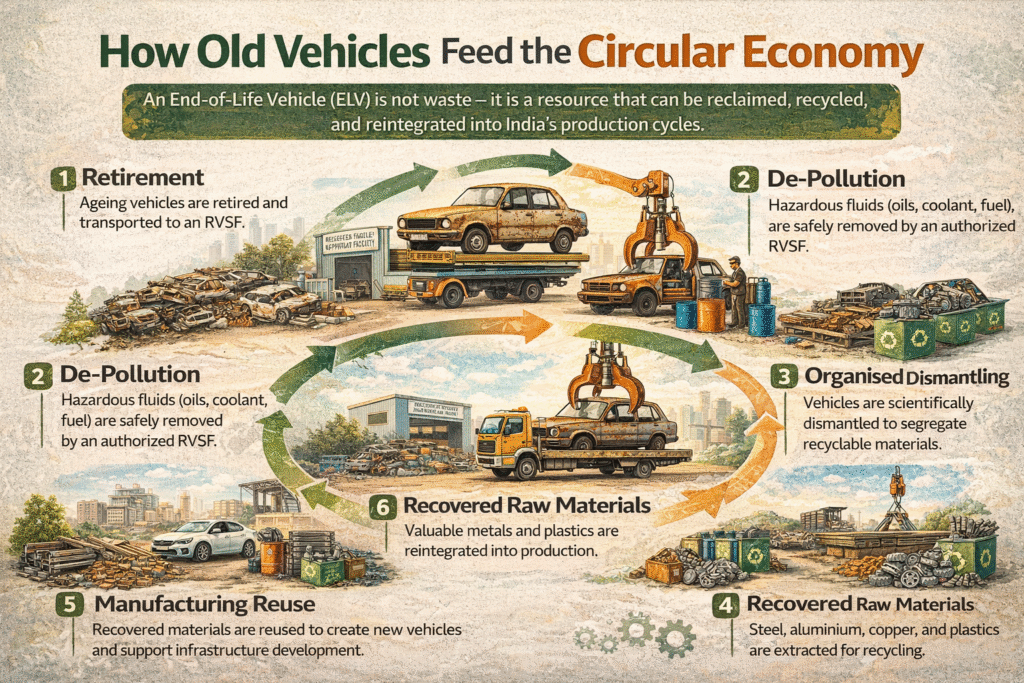
But in a structured system, an End-of-Life Vehicle (ELV) is not waste. It is a resource.
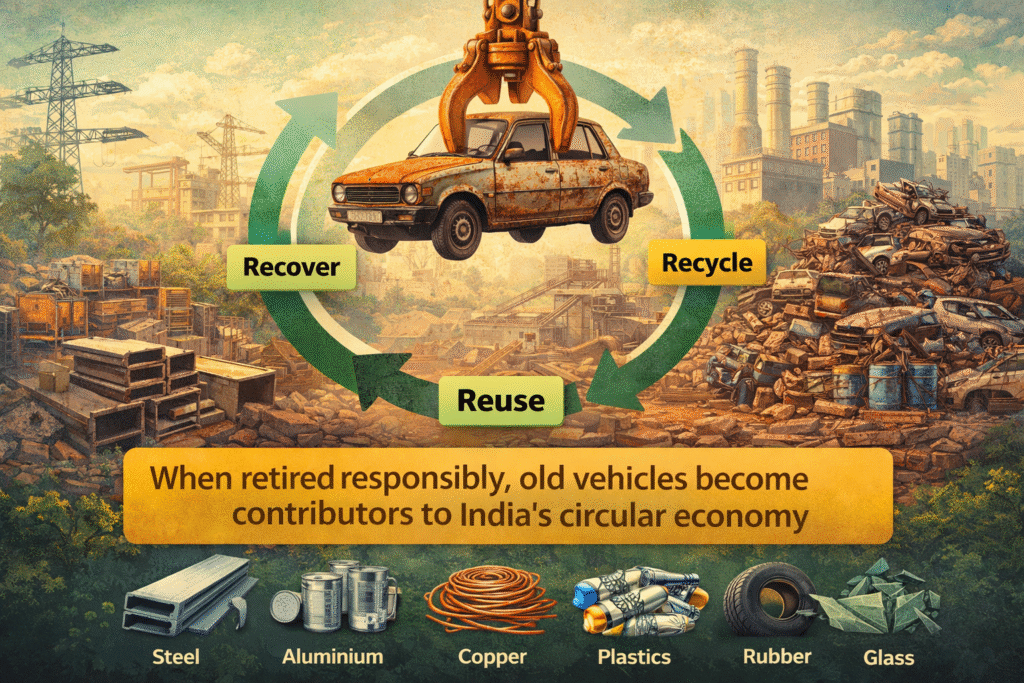
When retired responsibly, old vehicles become contributors to India’s circular economy — where materials are recovered, reused, and reintegrated into production instead of discarded.
From Linear to Circular
The traditional model of consumption is linear:
Extract → Manufacture → Use → Dispose
The circular economy replaces disposal with recovery:
Extract → Manufacture → Use → Recover → Recycle → Reuse
Vehicles are uniquely suited to circular recovery because a significant portion of their materials can be reclaimed and reprocessed.
A typical vehicle contains:
- Steel and iron
- Aluminium
- Copper
- Plastics
- Rubber
- Glass
When dismantled scientifically, many of these materials can re-enter manufacturing cycles.
The Resource Value of Old Vehicles
Steel and aluminium recovered from scrapped vehicles can be used in:
- Automotive manufacturing
- Construction
- Infrastructure development
Recycled metals require substantially less energy than producing virgin material. This reduces:
- Energy consumption
- Industrial emissions
- Raw material extraction pressure
In a country with rising infrastructure demand, material recovery plays a strategic role.
Why Informal Scrapping Breaks the Cycle
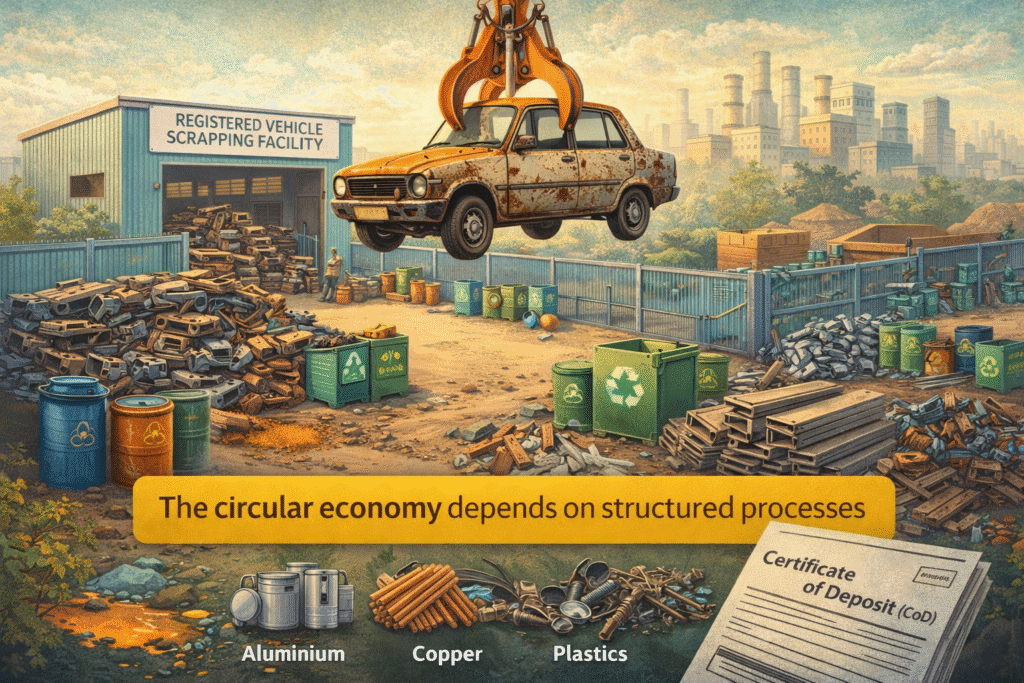
The circular economy depends on structured processes.
Illegal or informal dismantling:
- Fails to properly remove hazardous fluids
- Wastes recoverable materials
- Creates environmental contamination
- Operates outside documented recycling streams
Without scientific de-pollution and organised material segregation, valuable resources are lost.
A true circular system requires authorised facilities and transparent documentation.
The Role of Registered Vehicle Scrapping Facilities
In regulated regions such as Delhi NCR — including Delhi, Haryana, Uttar Pradesh, Rajasthan, and areas like Hapur (Delhi NCR) — diesel vehicles older than 10 years and petrol vehicles older than 15 years are classified as End-of-Life Vehicles (ELVs).
When these vehicles are retired through a government-approved Registered Vehicle Scrapping Facility (RVSF), the process includes:
- Scientific de-pollution
- Safe extraction of oils, coolants, and batteries
- Segregation of recyclable metals and components
- Environmentally compliant dismantling
DosNextGen India Private Limited operates an authorised RVSF aligned with national vehicle scrappage policy guidelines.
Upon scrapping, vehicle owners receive a Certificate of Deposit (CoD), which:
- Confirms lawful dismantling
- Enables formal de-registration
- Supports eligibility for potential benefits on new vehicle purchases
This documentation ensures that the vehicle exits the road legally and re-enters the economy responsibly.
Environmental and Economic Benefits
Responsible vehicle recycling supports:
- Reduced landfill burden
- Lower industrial energy use
- Decreased demand for virgin metal extraction
- Job creation in organised recycling sectors
- Improved environmental compliance
Instead of becoming unmanaged waste, old vehicles become raw material contributors.
Closing the Loop
The circular economy is not an abstract concept. It is a practical system built on responsible choices.
Retiring an old vehicle through authorised channels:
- Removes a high-emission asset from the road
- Prevents environmental contamination
- Recovers valuable materials
- Supports sustainable manufacturing
At DosNextGen India Private Limited, we view End-of-Life Vehicles not as liabilities, but as inputs into a more resource-efficient economy.
Because when managed responsibly, old vehicles do not end their journey — they begin a new one.
For authorised vehicle scrapping support:
DosNextGen India Private Limited
📞 +91 93246 89358
📧 info@dosnextgen.com
🌐 www.dosnextgen.com