
By DosNextGen India Private Limited
Every morning, millions of children across India begin their day inside a school bus or van. For many, that journey lasts 30 to 90 minutes — in enclosed vehicles moving through dense traffic.
When school transport relies on ageing, high-emission vehicles, children are exposed to concentrated exhaust fumes during some of their most vulnerable developmental years.
Clean air does not begin at the classroom door. It begins with the vehicle that brings a child there.
Children Are More Vulnerable to Air Pollution
Scientific research consistently shows that children are more sensitive to air pollution than adults because:
- Their lungs are still developing
- They breathe more rapidly
- They spend more time outdoors
- Their immune systems are less mature
Exposure to vehicle emissions — particularly particulate matter (PM), nitrogen oxides (NOx), and carbon monoxide (CO) — has been linked to respiratory irritation, reduced lung function, and increased asthma risk.
When outdated school buses idle outside gates or operate within neighbourhoods, emissions accumulate in exactly the spaces where children gather.
The Ageing Vehicle Challenge
In regulated regions such as Delhi NCR — including Delhi, Haryana, Uttar Pradesh, Rajasthan, and areas like Hapur (Delhi NCR) — the following are classified as End-of-Life Vehicles (ELVs):
- Diesel vehicles older than 10 years
- Petrol vehicles older than 15 years
Many older school buses and vans were manufactured under earlier emission standards and lack advanced pollution control systems found in Bharat Stage VI (BS-VI) vehicles.
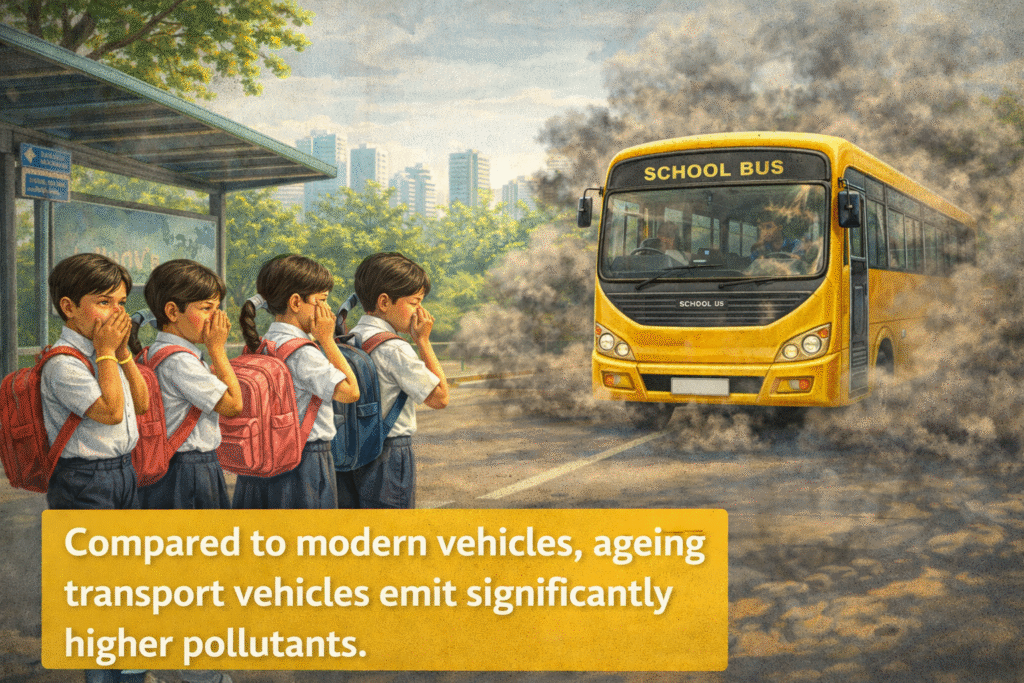
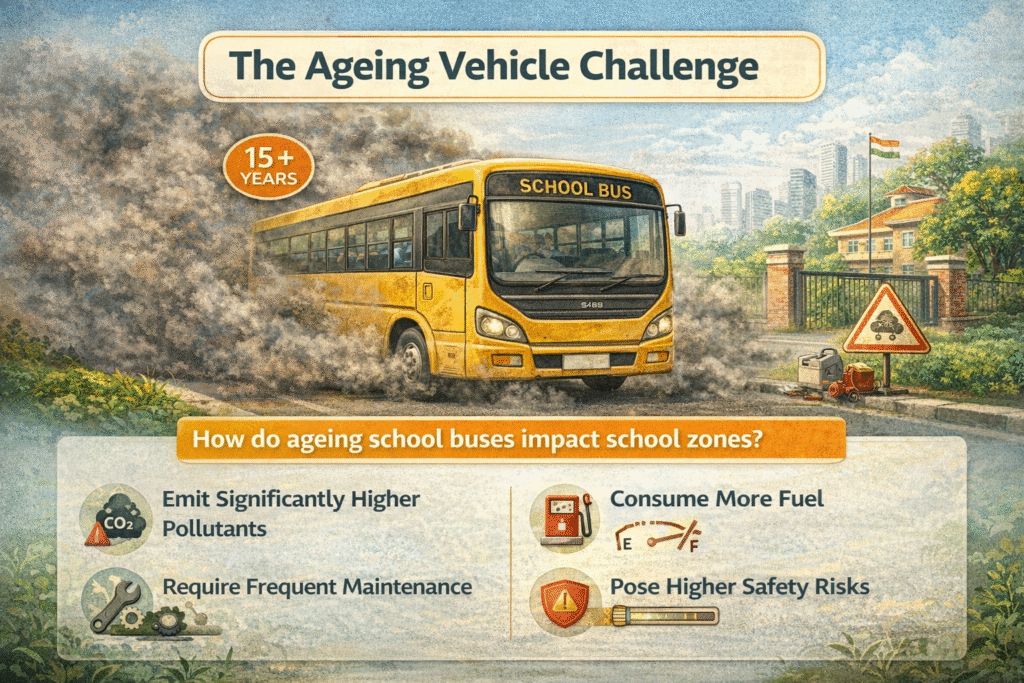
Compared to modern vehicles, ageing transport vehicles:
- Emit significantly higher pollutants
- Consume more fuel
- Require frequent maintenance
- Pose higher safety risks
When these vehicles operate daily in school zones, the environmental and health implications multiply.
Idling Outside School Gates
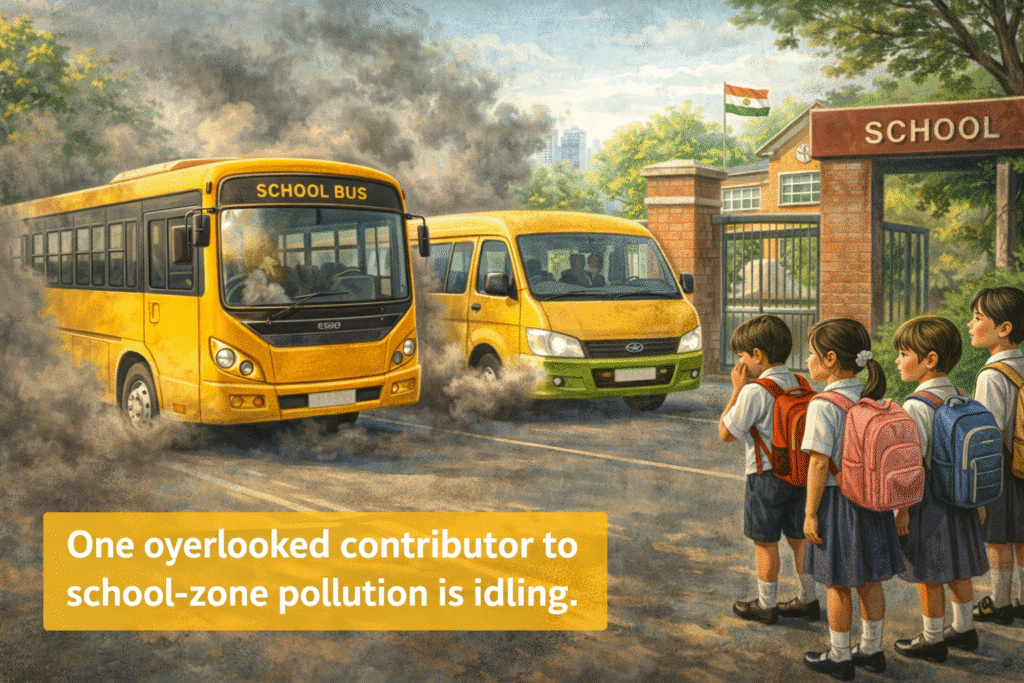
One overlooked contributor to school-zone pollution is idling.
Drivers often keep engines running while waiting for students. In high-density areas, dozens of buses and vans may idle simultaneously.
The result:
- Concentrated exhaust near entrances
- Increased particulate exposure at child height
- Compromised air quality during peak school hours
Reducing idling and modernising fleets can significantly lower exposure.
Clean Transport Is Institutional Responsibility
Schools are centres of learning and care. Environmental responsibility must extend beyond classrooms and into operational practices.
Modernising school transport fleets:
- Improves air quality in school zones
- Enhances student safety
- Reduces fuel costs over time
- Strengthens institutional credibility
Retiring End-of-Life Vehicles through authorised channels ensures that outdated transport is not simply transferred elsewhere, but responsibly dismantled.
The Role of Authorised Vehicle Scrapping
DosNextGen India Private Limited operates a government-approved Registered Vehicle Scrapping Facility (RVSF), providing:
- Scientific de-pollution of vehicles
- Safe removal of hazardous fluids and components
- Environmentally compliant dismantling
- Transparent documentation
Upon scrapping, vehicle owners receive a Certificate of Deposit (CoD), which:
- Confirms lawful dismantling
- Enables formal de-registration
- Supports eligibility for potential benefits on new vehicle purchases
For school managements and transport operators, this ensures regulatory compliance and responsible closure.
A Healthier Start to Every Day
Clean school uniforms and healthy meals are prioritised across institutions. Clean transport deserves equal attention.
Retiring ageing school vehicles is not merely regulatory compliance — it is an investment in student health, community well-being, and environmental responsibility.
At DosNextGen India Private Limited, we support institutions in responsibly transitioning away from End-of-Life Vehicles through authorised, compliant processes.
Because clean air for children should begin with the journey — not just the destination.
For institutional fleet scrapping support:
DosNextGen India Private Limited
📞 +91 93246 89358
📧 info@dosnextgen.com
🌐 www.dosnextgen.com