
By DosNextGen India Private Limited
For many vehicle owners, scrapping an old car appears straightforward: hand it over, receive payment, move on. But there is a critical legal step that is frequently overlooked — de-registration.
Without formal de-registration through authorised channels, a vehicle’s lifecycle does not truly end. It remains recorded in government databases, potentially exposing the registered owner to future liability.
Understanding de-registration is essential to responsible vehicle retirement.
What Is De-Registration?
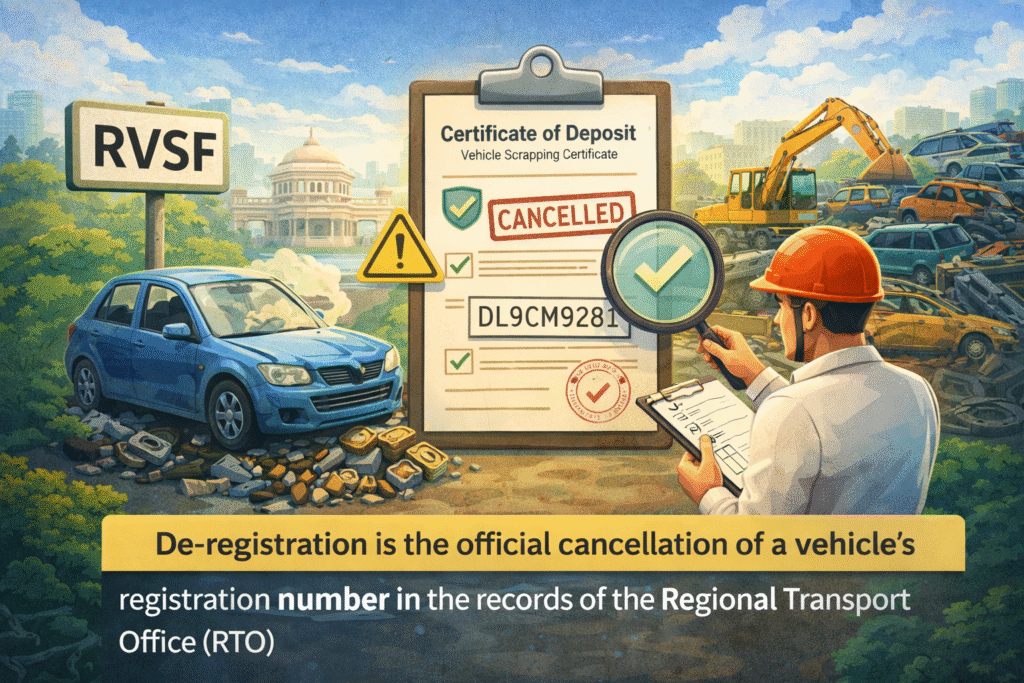
De-registration is the official cancellation of a vehicle’s registration number in the records of the Regional Transport Office (RTO). It legally confirms that the vehicle:
- Is no longer operational
- Has been permanently removed from circulation
- Cannot be reused or resold
- Is dismantled in accordance with government norms
In simple terms, de-registration closes the legal identity of the vehicle.
Many owners assume that selling a vehicle for scrap automatically completes this process. It does not — unless the scrapping is conducted through an authorised Registered Vehicle Scrapping Facility (RVSF).
Why It Matters
Failure to de-register can create serious complications:
- The vehicle may remain active in official databases
- Traffic violations linked to reused number plates may trace back to the original owner
- Liability in case of illegal reuse or misuse may persist
- Insurance and tax records may not reflect closure
An incomplete scrapping process can become a future legal burden.
Across Delhi NCR — including Delhi, Haryana, Uttar Pradesh, Rajasthan, and areas such as Hapur (Delhi NCR) — enforcement around End-of-Life Vehicles (ELVs) has intensified. Diesel vehicles older than 10 years and petrol vehicles older than 15 years fall under strict compliance frameworks.
De-registration ensures alignment with these regulations.
The Role of Authorised Scrapping
DosNextGen India Private Limited operates a government-approved RVSF, where scrapping is not merely dismantling — it is a structured regulatory process.
At an authorised facility:
- Vehicle ownership documents are verified
- The vehicle is securely de-registered
- Hazardous materials are safely removed
- Scientific dismantling is conducted
- Recyclable materials are processed
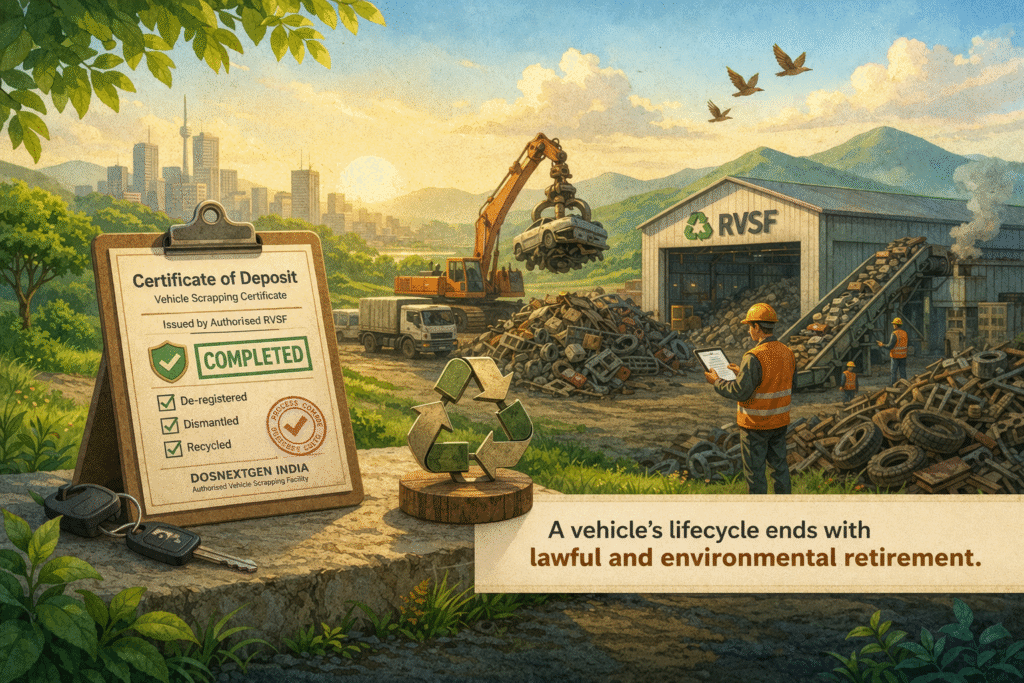
Upon completion, the owner receives a Certificate of Deposit (CoD) — commonly known as a Vehicle Scrapping Certificate.
Certificate of Deposit (CoD): Proof of Closure
The Certificate of Deposit (CoD) is more than a receipt. It is:
- Official proof of lawful scrapping
- Confirmation of de-registration initiation
- Protection against future misuse
- Eligibility documentation for potential benefits on new vehicle purchases
Without a valid Certificate of Deposit (CoD), the scrapping process remains incomplete from a legal standpoint.
Through DOSNEXTGEN INDIA, every Certificate of Deposit (CoD) reflects full compliance with national vehicle scrappage policy.
The Step Owners Often Miss
In informal scrapping arrangements, de-registration is frequently neglected. Vehicles may be dismantled physically but remain digitally alive in official records.
This gap between physical disposal and legal closure creates risk.
Responsible vehicle retirement requires both:
- Environmental dismantling
- Administrative finalisation
Skipping either step compromises the integrity of the process.
A Responsible Conclusion
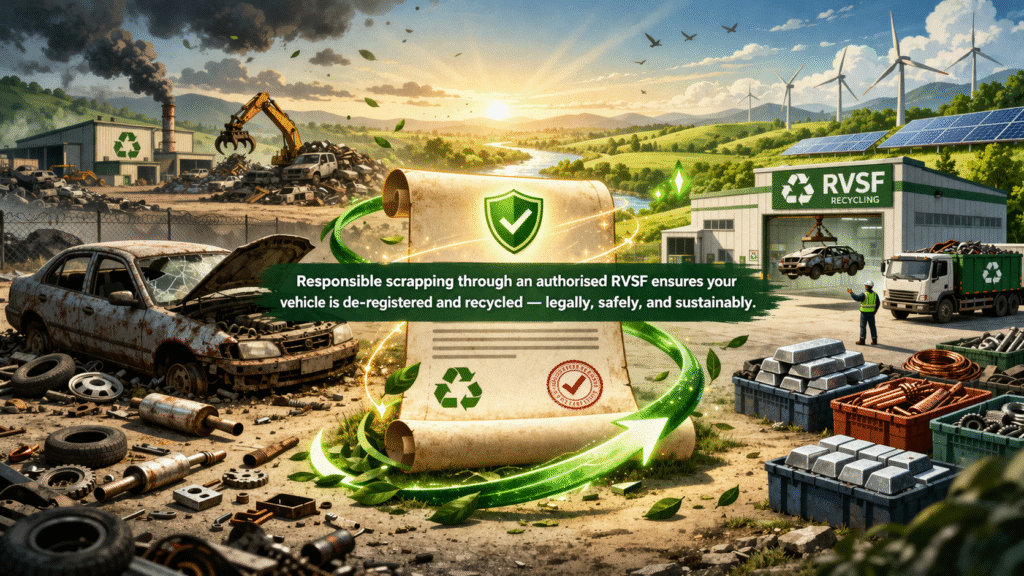
A vehicle’s lifecycle does not end when it stops running. It ends when it is legally and environmentally retired.
As India advances toward cleaner mobility and stricter compliance norms, proper de-registration is no longer optional — it is essential.
At DOSNEXTGEN INDIA, scrapping is handled with regulatory precision and procedural transparency. Owners are guided through the full lifecycle closure process, ensuring that nothing remains pending.
De-registration is the step most owners miss. It should be the step they prioritise.
Close the Chapter Properly — Scrap and De-Register with Confidence.
📞 +91 93246 89358
📧 info@dosnextgen.com
🌐 www.dosnextgen.com