
By DosNextGen India Private Limited
When discussions around ageing vehicles arise, the focus often centres on pollution, fuel inefficiency, or regulatory compliance. Yet one critical dimension frequently remains overlooked: fire safety.
Across India’s dense urban neighbourhoods, residential societies, commercial complexes, and roadside parking zones, ageing and End-of-Life Vehicles (ELVs) quietly pose a growing fire risk.
This is not alarmism. It is mechanical reality.
The Mechanical Vulnerability of Ageing Vehicles
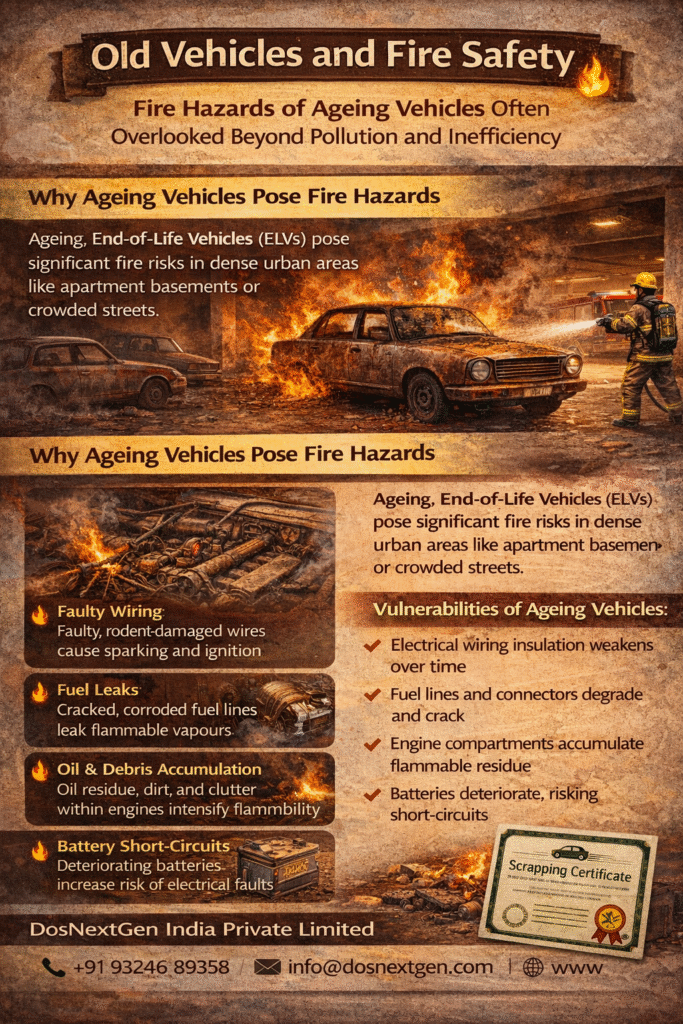
Vehicles are engineered systems designed to operate within defined lifespans. Over time, components degrade:
- Electrical wiring insulation weakens
- Fuel lines crack or corrode
- Engine compartments accumulate oil residue
- Batteries deteriorate
- Aftermarket modifications compromise safety systems
In older diesel vehicles beyond 10 years and petrol vehicles beyond 15 years — now classified as End-of-Life Vehicles under prevailing norms — the risk profile increases significantly.
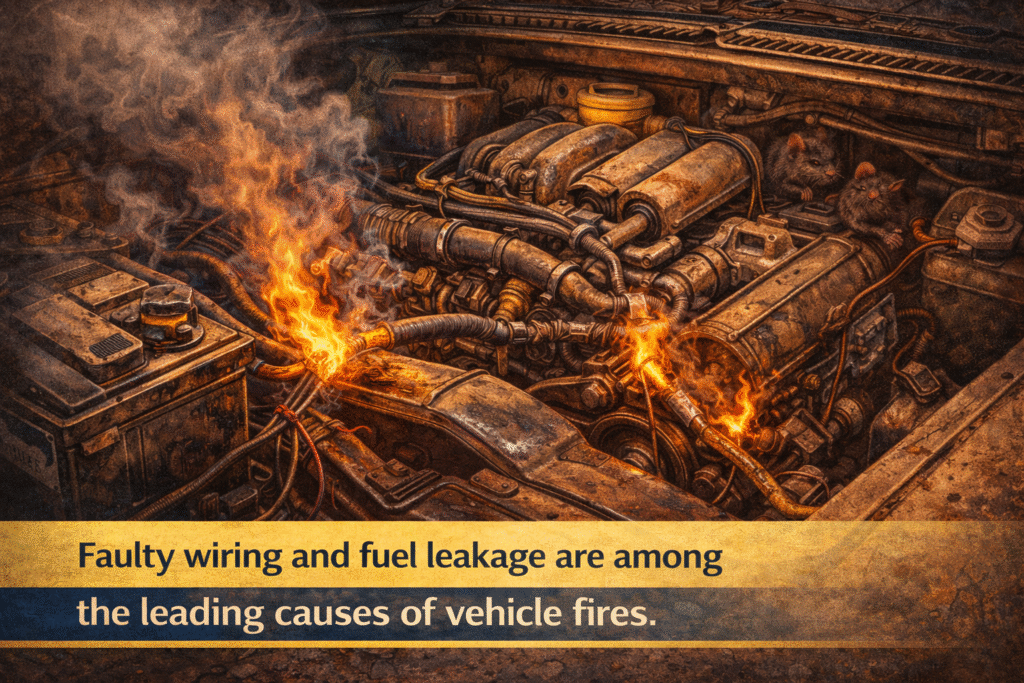
Faulty wiring and fuel leakage are among the leading causes of vehicle fires. When maintenance declines or vehicles remain unused for extended periods, deterioration accelerates.
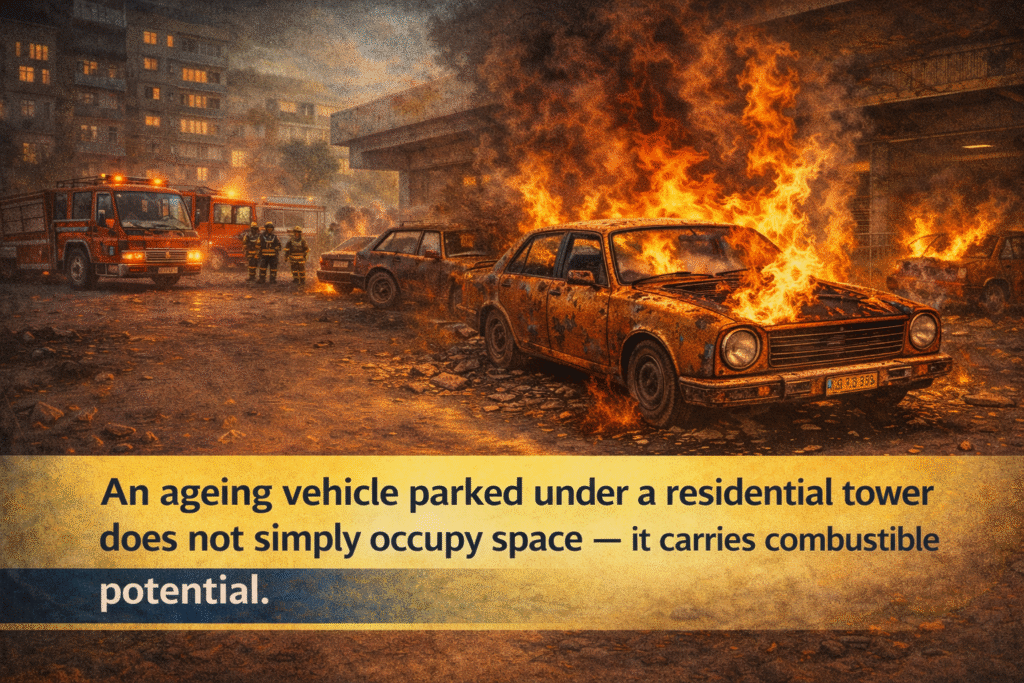
An ageing vehicle parked in a basement, under a residential tower, or along a narrow lane does not simply occupy space — it carries combustible potential.
Urban Density Amplifies Risk
In high-density regions such as Delhi NCR — including Delhi, Haryana, Uttar Pradesh, Rajasthan, and areas like Hapur (Delhi NCR) — parking infrastructure is already under strain.
When older vehicles are left stationary for long durations:
- Batteries may short-circuit
- Rodent damage to wiring increases ignition risk
- Fuel vapours accumulate
- Heat exposure intensifies degradation
In confined parking areas, a single ignition can escalate rapidly, threatening adjacent vehicles, residential buildings, and lives.
Fire departments across urban India regularly report vehicle fires linked to electrical faults and ageing mechanical systems.
Fire safety is not only about extinguishers and alarms. It is also about reducing ignition sources.
Environmental and Safety Intersection
Vehicle fires release dense toxic smoke, heavy metals, and hazardous residues. Beyond immediate danger, they compound environmental damage.
Thus, retaining ageing vehicles does not merely pose a regulatory concern. It introduces safety and environmental vulnerability.
Responsible retirement reduces both.
Structured Decommissioning as Risk Prevention
DosNextGen India Private Limited operates a government-approved Registered Vehicle Scrapping Facility (RVSF), ensuring that ageing vehicles are dismantled in a controlled, environmentally compliant manner.
The scrapping process includes:
- Safe removal of fuel and hazardous fluids
- Battery neutralisation
- Scientific dismantling
- Segregation and recycling of recoverable materials
Upon completion, owners receive a Certificate of Deposit (CoD) — commonly known as a Vehicle Scrapping Certificate.
The Certificate of Deposit (CoD) formally confirms that the vehicle has been decommissioned in accordance with government standards. It provides legal closure while eliminating long-term mechanical and fire-related risk.
Through DOSNEXTGEN INDIA, the Certificate of Deposit (CoD) represents more than documentation. It represents preventive safety.
A Preventive Approach to Urban Safety
Fire risk often emerges from neglect rather than intention. Vehicles that once served families faithfully can become liabilities when retained beyond their functional life.
Choosing authorised scrapping:
- Eliminates ageing ignition sources
- Frees congested parking spaces
- Reduces environmental hazard
- Aligns with national vehicle lifecycle policy
Across Delhi NCR and surrounding states, proactive retirement of End-of-Life Vehicles strengthens not only environmental outcomes but also community safety.
Responsibility Before Incident
Fire safety discussions often follow incidents. True responsibility lies in prevention.
An ageing vehicle may hold sentimental value. But sentiment cannot override structural risk.
By scrapping responsibly through DOSNEXTGEN INDIA, vehicle owners convert potential hazard into material recovery and regulatory compliance.
Urban safety is a shared obligation. Removing fire-prone, deteriorating vehicles from circulation is a practical and measurable step.
At DosNextGen India Private Limited, responsible vehicle retirement is not merely an environmental service — it is a contribution to safer cities.
Protect Your Community. Retire Risk Responsibly.
📞 +91 93246 89358
📧 info@dosnextgen.com
🌐 www.dosnextgen.com