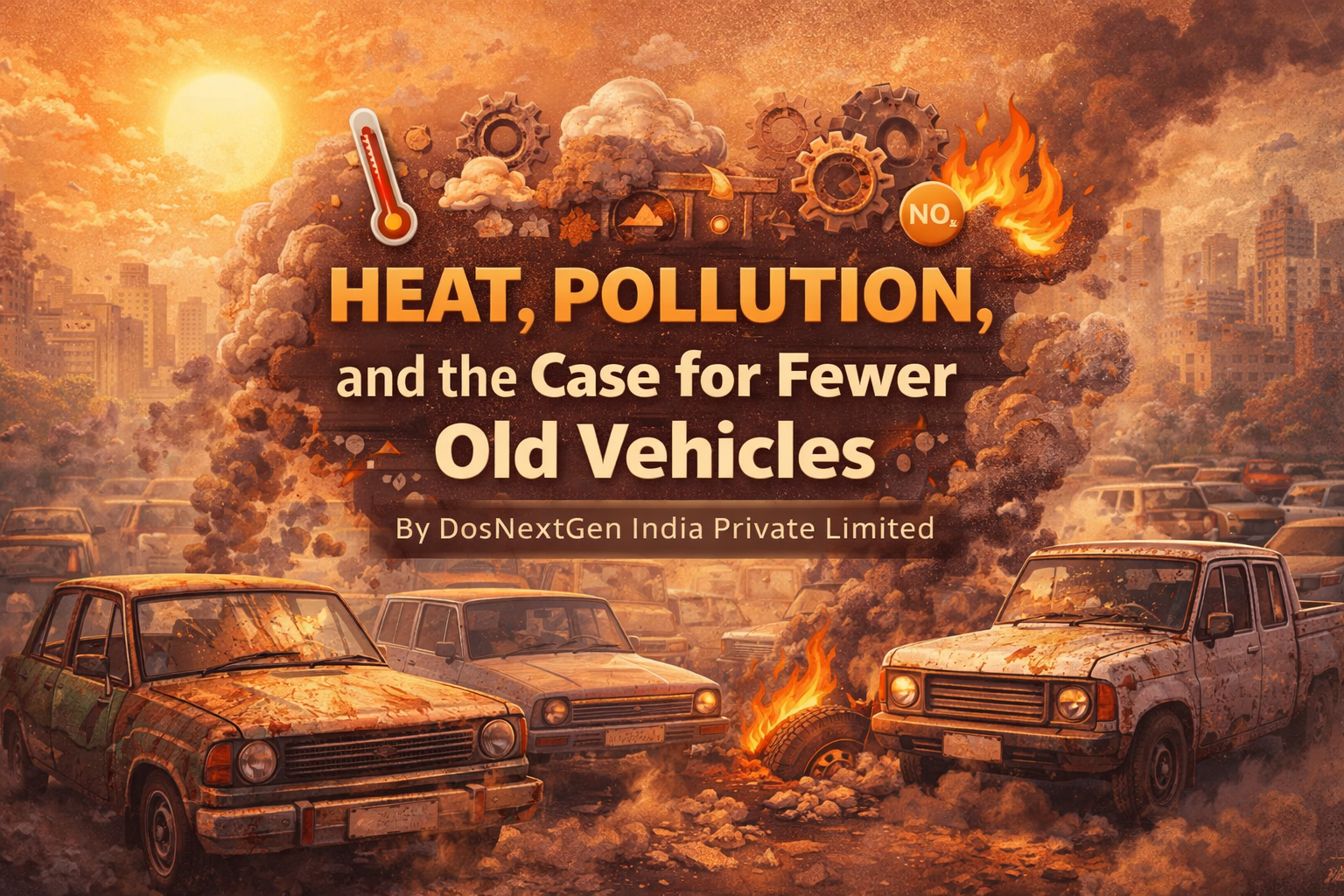

By DosNextGen India Private Limited
India stands at a decisive moment in its energy journey. As one of the world’s fastest-growing economies, the nation has committed itself to reducing carbon intensity, expanding renewable capacity, and lowering dependence on imported fossil fuels. These ambitions are not abstract targets. They are central to economic resilience, public health, and national security.
Yet, quietly and persistently, fuel-inefficient vehicles continue to undermine that progress.
The Energy Equation on Indian Roads
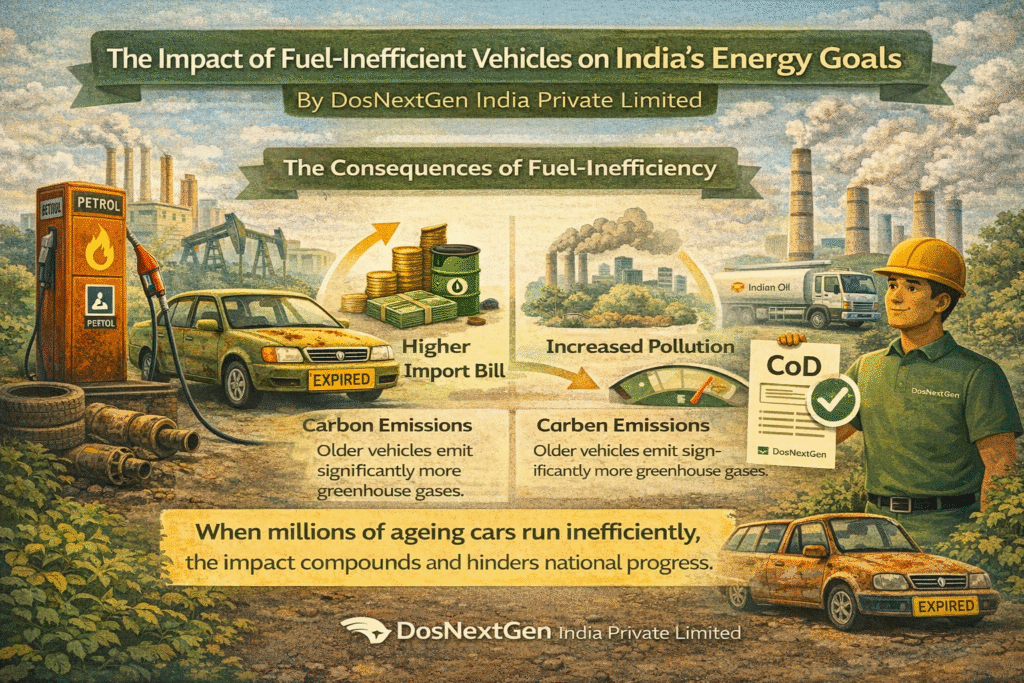
India imports a significant portion of its crude oil requirements. Every additional litre of fuel consumed on Indian roads strengthens this dependence. Older, fuel-inefficient vehicles — particularly those built before stricter emission and efficiency standards — consume considerably more fuel per kilometre than modern alternatives.
This inefficiency has layered consequences:
- Increased national fuel demand
- Higher import expenditure
- Greater greenhouse gas emissions
- Elevated urban air pollution
When multiplied across millions of ageing vehicles, the impact becomes systemic.
Under current norms, diesel vehicles older than 10 years and petrol vehicles older than 15 years are classified as End-of-Life Vehicles (ELVs). Many of these vehicles were manufactured before Bharat Stage VI (BS-VI) standards, meaning they operate at significantly lower efficiency and higher emission thresholds.
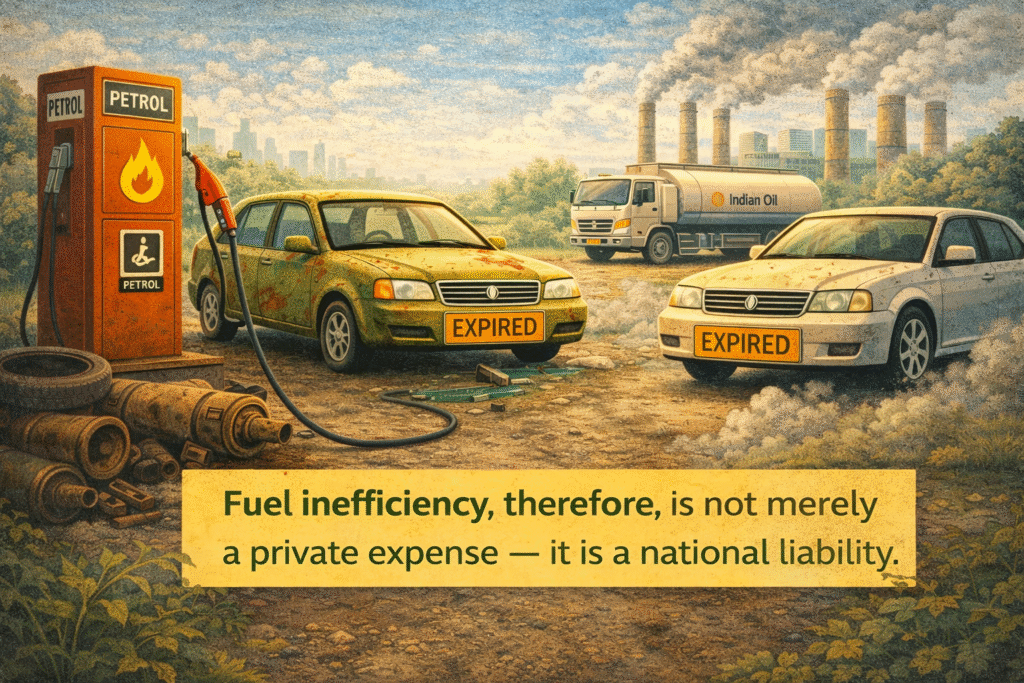
Fuel inefficiency, therefore, is not merely a private expense — it is a national liability.
Environmental and Economic Consequences
Fuel-inefficient engines burn more petrol or diesel to travel the same distance. This increases:
- Carbon dioxide emissions
- Nitrogen oxides and particulate matter
- Operational costs for owners
- Pressure on India’s fuel import bill
India’s energy transition strategy emphasises electrification, biofuels, and improved efficiency standards. However, retaining high-consumption vehicles on the road slows this transition.
Even intermittent usage of ageing vehicles contributes disproportionately to emissions. A poorly maintained, outdated engine can emit significantly more pollutants than a modern BS-VI compliant vehicle.
Energy conservation does not begin at power plants alone. It begins in driveways.
The Role of Responsible Vehicle Retirement
Scrapping outdated vehicles through an authorised Registered Vehicle Scrapping Facility (RVSF) is not simply a regulatory compliance step — it is an energy correction measure.
DosNextGen India Private Limited operates a government-approved RVSF committed to environmentally responsible dismantling and recycling. Through structured processes, vehicles are safely decommissioned, hazardous materials neutralised, and recyclable metals recovered.
Upon scrapping, owners receive a Certificate of Deposit (CoD) — commonly known as a Vehicle Scrapping Certificate. The Certificate of Deposit (CoD) confirms that the vehicle has been dismantled in accordance with government guidelines and allows owners to access applicable benefits when purchasing a new vehicle.
By replacing a fuel-inefficient vehicle with a modern, energy-efficient alternative, owners directly reduce:
- Fuel consumption
- Emission intensity
- Maintenance expenditure
DOSNEXTGEN INDIA ensures that each Certificate of Deposit (CoD) is issued following full compliance, providing legal and environmental assurance.
Strengthening India’s Energy Security
India’s energy goals are ambitious:
- Reduce carbon intensity of GDP
- Increase renewable energy capacity
- Improve fuel efficiency across sectors
- Reduce oil import dependence
These goals cannot be achieved solely through policy announcements. They require structural shifts in everyday choices.
Fuel-inefficient vehicles represent a hidden drag on national efficiency. Phasing them out accelerates:
- Cleaner air outcomes
- Reduced oil demand
- Stronger circular economy through metal recycling
- Modernisation of India’s vehicle fleet
In regions across Delhi NCR — including Delhi, Haryana, Uttar Pradesh, Rajasthan, and areas such as Hapur (Delhi NCR) — the move towards stricter enforcement reflects a broader alignment with national energy priorities.
Responsibility Beyond Sentiment
Many ageing vehicles remain on roads due to familiarity and emotional attachment. But energy responsibility requires difficult transitions.
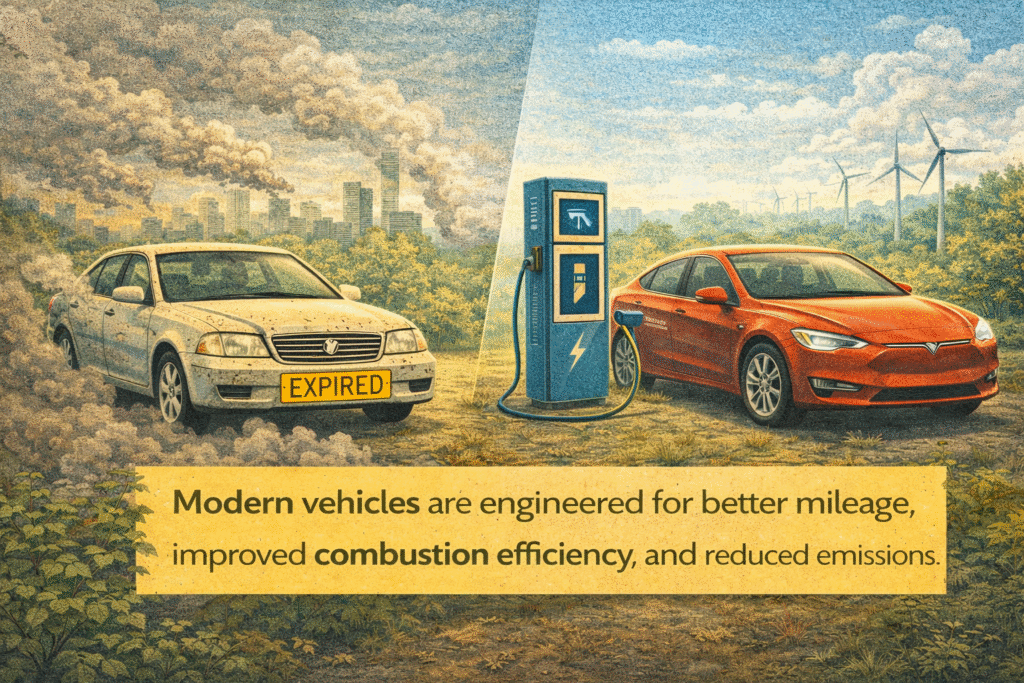
Modern vehicles are engineered for better mileage, improved combustion efficiency, and reduced emissions. Continuing to operate older, fuel-intensive vehicles increases collective energy strain.
Scrapping is not the end of a vehicle’s story; it is the responsible conclusion of its lifecycle.
Through DOSNEXTGEN INDIA, vehicle owners can align personal decisions with national priorities — strengthening India’s energy resilience one vehicle at a time.
Make Energy Efficiency a Personal Commitment — Scrap Responsibly Today.
📞 +91 93246 89358
📧 info@dosnextgen.com
🌐 www.dosnextgen.com