

By DosNextGen India Private Limited
Cities are designed for movement — of people, goods, ideas, and opportunity.
They are not designed for indefinite vehicle storage.
Yet across urban India, ageing and unused vehicles occupy residential basements, roadside stretches, society parking bays, and commercial lots. What was once a functional asset gradually becomes a static burden — on space, safety, and sustainability.
As urban density increases, the question becomes unavoidable: can cities afford to store vehicles that no longer serve mobility?
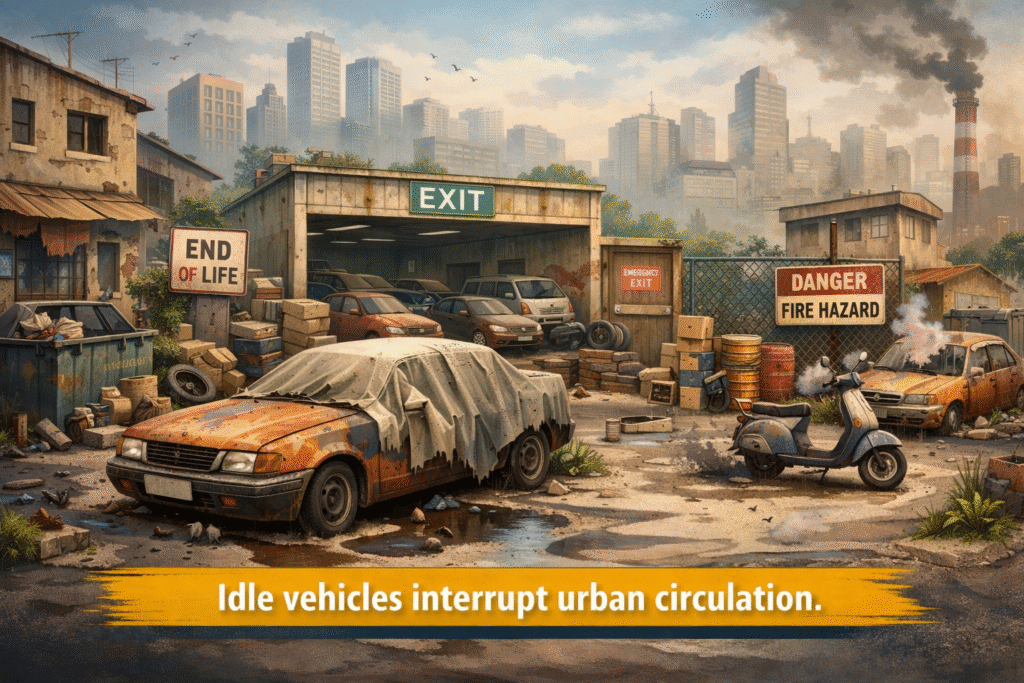
The Urban Space Equation
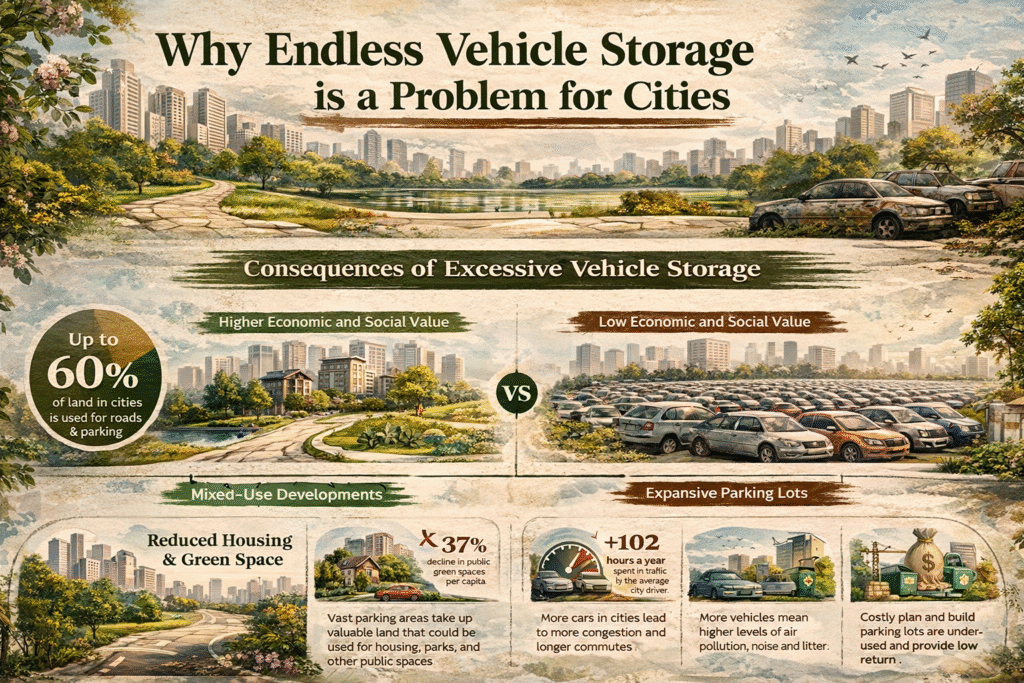
Land in cities is finite and expensive. Every square metre allocated to vehicle storage is space not available for:
- Pedestrian movement
- Emergency access
- Green cover
- Community infrastructure
- Active parking for operational vehicles
In high-density corridors such as Delhi NCR — including Delhi, Haryana, Uttar Pradesh, Rajasthan, and areas like Hapur (Delhi NCR) — space constraints are already acute.
When diesel vehicles older than 10 years and petrol vehicles older than 15 years reach End-of-Life Vehicle (ELV) classification, continued parking without lawful use creates structural inefficiency.
Urban design prioritises circulation. Idle vehicles interrupt it.
The Safety Dimension
Vehicles that remain parked for extended periods can present risks:
- Fluid leakage contaminating surfaces
- Battery deterioration
- Tyre degradation
- Increased fire vulnerability
- Obstructed evacuation routes in basements
In residential complexes and commercial buildings, such risks affect not only the owner but the wider community.
Urban storage without oversight is not neutral — it carries consequences.
Pollution Does Not Pause
Even stationary vehicles contribute to environmental stress.
Evaporation of residual fuel, oil seepage, and gradual material decay introduce pollutants into urban ecosystems.
More importantly, when End-of-Life Vehicles remain unretired, they often re-enter circulation intermittently — contributing higher emissions compared to modern Bharat Stage VI (BS-VI) compliant vehicles.
Urban air quality depends not only on reducing traffic volume but also on reducing the number of ageing, high-emission engines.
Ownership and Responsibility
Vehicle ownership does not imply lifetime parking entitlement.
When a vehicle has reached regulatory age or operational inefficiency, responsible closure becomes part of responsible ownership.
Formal retirement ensures:
- Removal of high-emission vehicles from roads
- Reclaimed parking space
- Environmental protection
- Legal compliance
The process must, however, be structured and authorised.
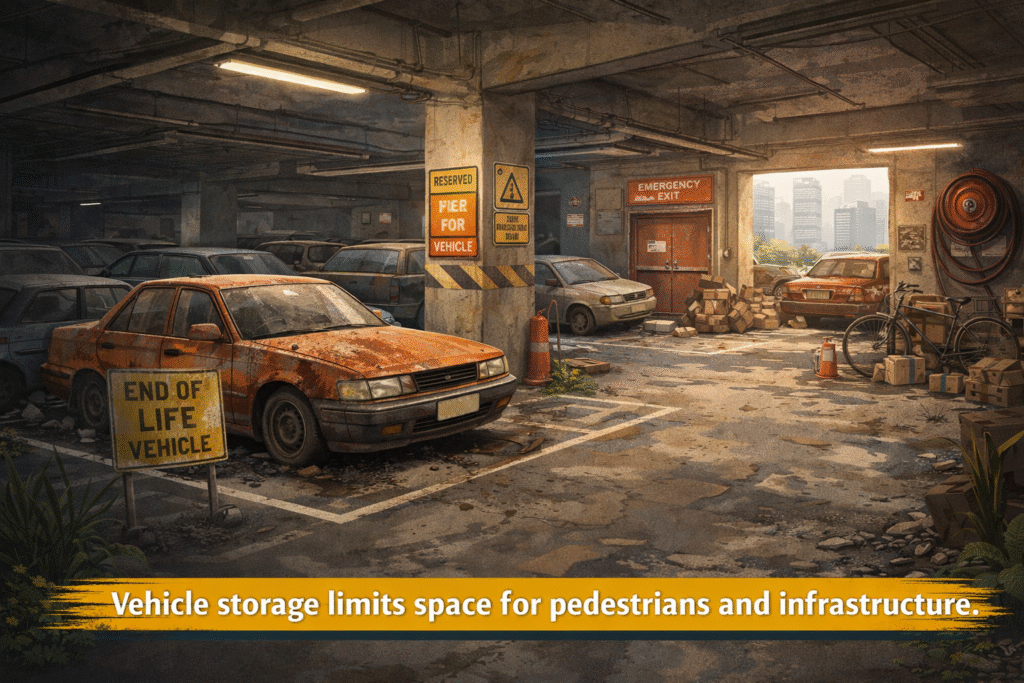
Responsible Exit Through Authorised Channels
Informal disposal leaves environmental hazards and documentation gaps.
DosNextGen India Private Limited operates a government-approved Registered Vehicle Scrapping Facility (RVSF), ensuring:
- Scientific de-pollution
- Safe removal of hazardous materials
- Environmentally compliant dismantling
- Transparent documentation
Upon scrapping, vehicle owners receive a Certificate of Deposit (CoD), which:
- Confirms lawful dismantling
- Enables formal de-registration
- Supports eligibility for potential benefits when purchasing new vehicles
This ensures that a vehicle’s lifecycle concludes in alignment with both urban planning and environmental responsibility.
Cities Must Move Forward
Modern cities are under pressure to:
- Reduce congestion
- Improve air quality
- Enhance safety
- Optimise land use
Endless storage of ageing vehicles undermines each of these goals.
Urban resilience requires circulation, renewal, and responsible transitions.
At DosNextGen India Private Limited, we support lawful and environmentally compliant vehicle retirement as part of sustainable urban development.
Because cities are built for progress — not for parking what no longer moves.
For authorised vehicle scrapping support:
DosNextGen India Private Limited
📞 +91 93246 89358
📧 info@dosnextgen.com
🌐 www.dosnextgen.com