
By DosNextGen India Private Limited
A vehicle left unused often appears harmless.
It sits quietly in a basement corner, under a tarpaulin in an open plot, or along the edge of a residential lane. It no longer consumes fuel. It no longer moves through traffic.
But silence does not mean neutrality.
Across Indian cities, thousands of ageing and End-of-Life Vehicles are not being driven — they are simply being stored. And that quiet neglect carries an environmental cost.
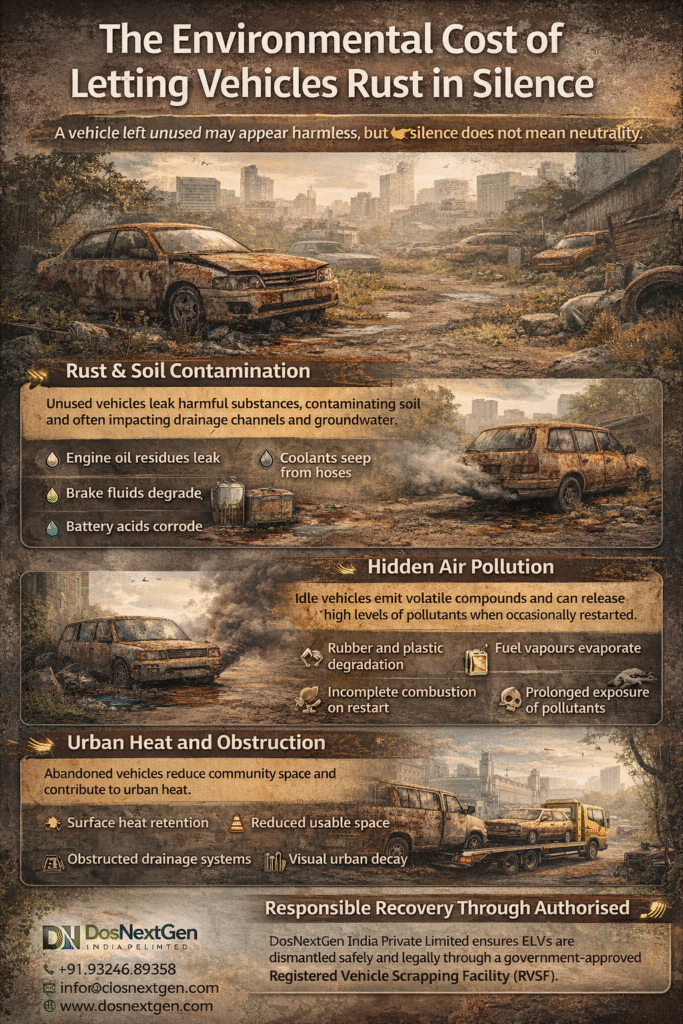
Rust Is a Chemical Process, Not Just a Visual One
When a vehicle deteriorates, it does not simply fade away.
Over time:
- Engine oil residues leak into the ground
- Coolants seep from ageing hoses
- Brake fluids degrade
- Battery acids corrode and contaminate surfaces
- Fuel vapours evaporate
These substances do not remain contained indefinitely. They enter soil, drainage systems, and in some cases, groundwater channels.
In dense urban regions such as Delhi NCR — including Delhi, Haryana, Uttar Pradesh, Rajasthan, and areas like Hapur (Delhi NCR) — limited open space increases the risk of environmental exposure from improperly stored vehicles.
The Hidden Air Impact
Even stationary vehicles contribute indirectly to pollution.
Ageing rubber, plastic, and fuel systems release volatile compounds over time. When such vehicles are occasionally restarted after long idle periods, they often emit disproportionately high levels of pollutants due to incomplete combustion.
Diesel vehicles older than 10 years and petrol vehicles older than 15 years are classified as End-of-Life Vehicles (ELVs) in regulated zones. Many such vehicles remain parked rather than formally retired.
Their environmental impact is delayed — not eliminated.
Urban Space and Heat Absorption
Abandoned or unused vehicles also contribute to:
- Surface heat retention
- Reduced usable community space
- Obstructed drainage systems
- Visual urban decay
Metal bodies absorb and radiate heat, adding to localised temperature rise in already heat-stressed environments.
What appears to be idle metal becomes part of the urban heat burden.
Informal Decay vs Structured Recovery
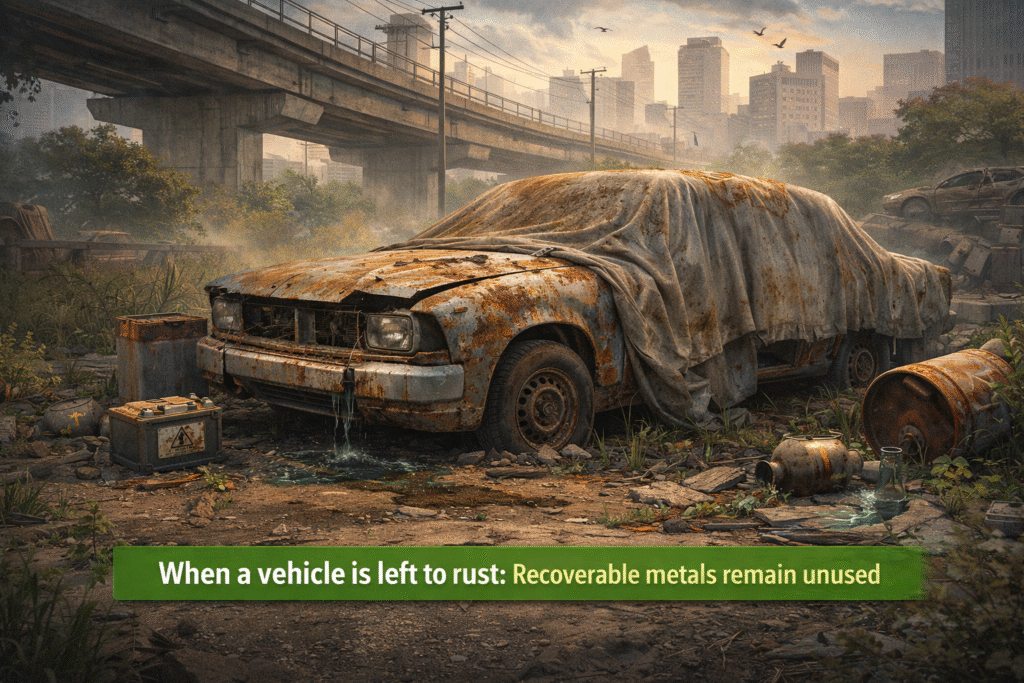
When a vehicle is left to rust:
- Recoverable metals remain unused
- Hazardous fluids remain unmanaged
- Ownership liability remains unresolved
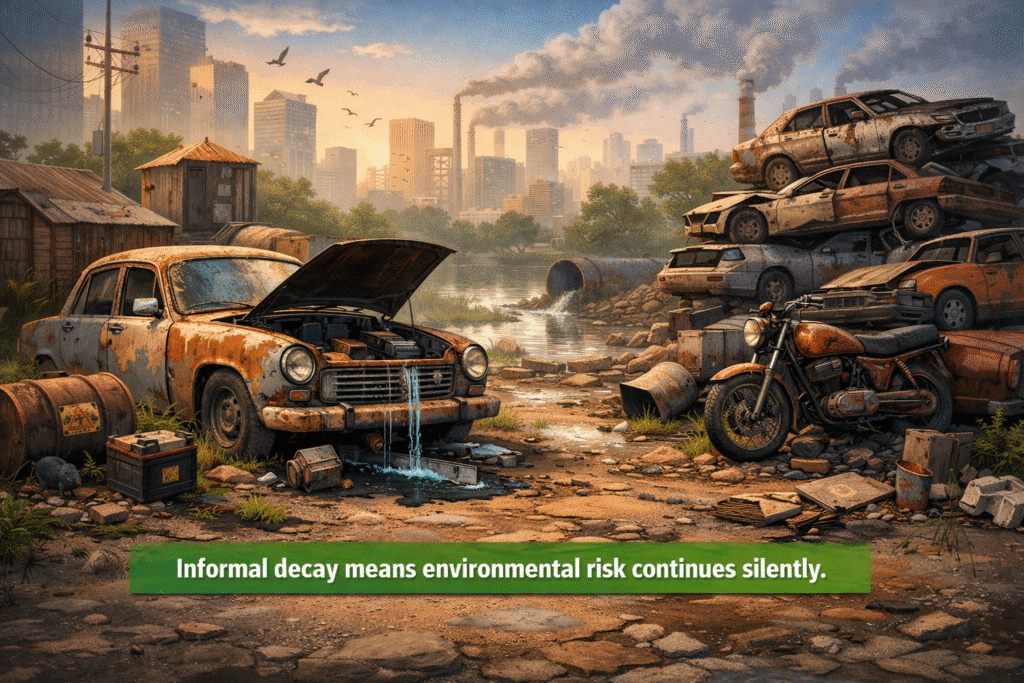
- Environmental risk continues silently
In contrast, responsible scrapping ensures:
- Scientific de-pollution
- Material segregation and recycling
- Proper hazardous waste disposal
- Documented lifecycle closure
DosNextGen India Private Limited operates a government-approved Registered Vehicle Scrapping Facility (RVSF), ensuring that End-of-Life Vehicles are dismantled in compliance with environmental standards.
Upon scrapping, owners receive a Certificate of Deposit (CoD), which:
- Confirms lawful dismantling
- Enables formal de-registration
- Provides documented closure of ownership responsibility
This transforms decay into structured recovery.
Silence Is Still Impact
Environmental damage is not always loud.
Sometimes it sits in parking lots.
Sometimes it occupies a roadside space.
Sometimes it rests under a cover, slowly deteriorating.
Responsible ownership requires recognising that inaction also carries consequences.
At DosNextGen India Private Limited, we support the lawful and environmentally compliant retirement of ageing vehicles.
Because when vehicles rust in silence, the environment quietly pays the price.
For authorised vehicle scrapping support:
DosNextGen India Private Limited
📞 +91 93246 89358
📧 info@dosnextgen.com
🌐 www.dosnextgen.com